
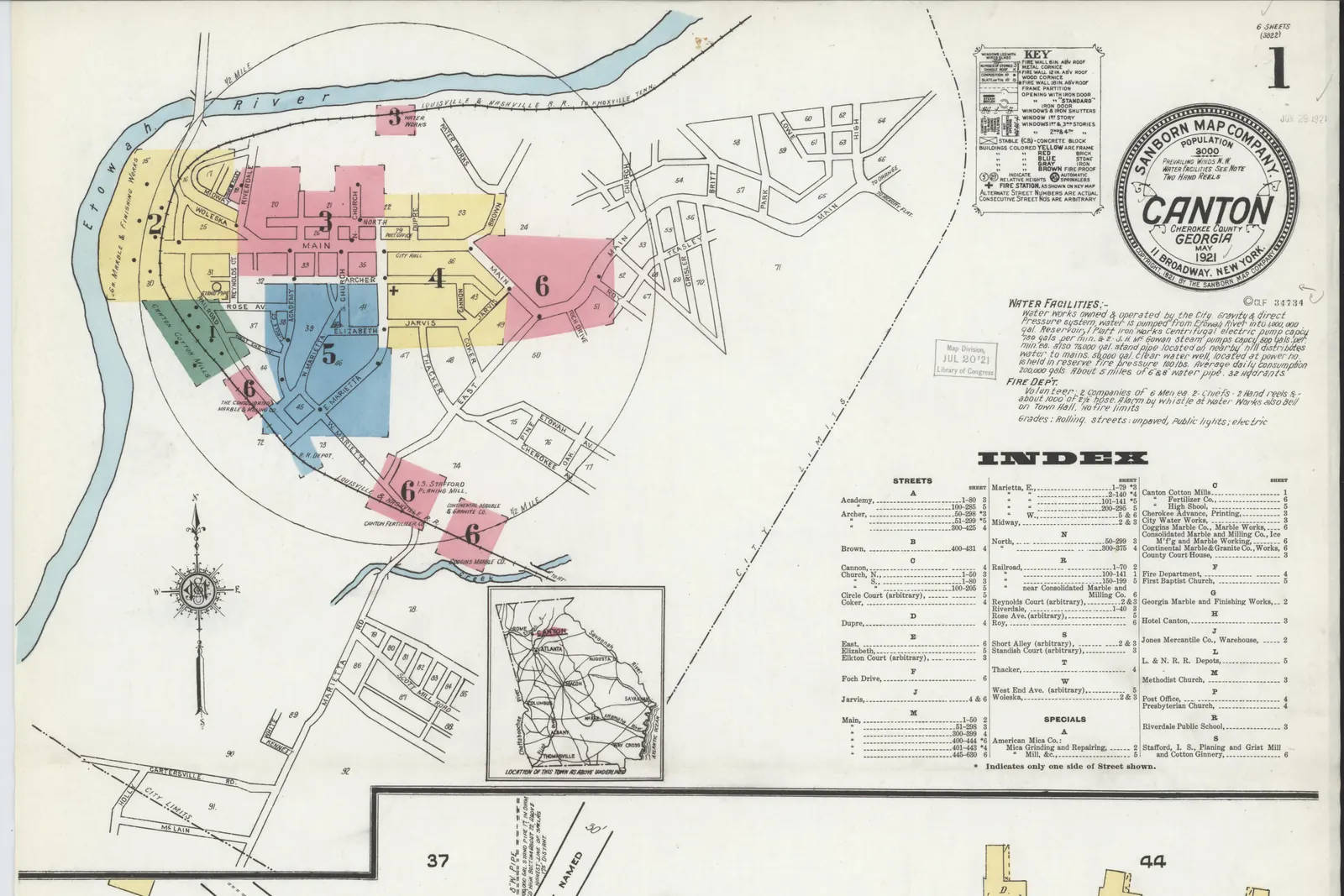
This history draws on the New Georgia Encyclopedia, the National Register nominations for the courthouse, the commercial district and Canton Cotton Mills No. 2, the City of Canton and History Cherokee. Where they disagree, on the year Canton got its name or when the mill stopped making denim, we say who says what instead of picking one quietly.
Timeline
- 1828: gold is discovered in the Cherokee Nation, and Georgia claims the land.
- By 1832: the town is called Cherokee Court House.
- 1833: it is incorporated as Etowah and named the county seat.
- 1834: the name changes to Canton, according to the New Georgia Encyclopedia.
- 1879: the Marietta and North Georgia Railroad is built through downtown. Robert Tyre Jones moves to Canton about this time and opens the Jones Mercantile Company.
- Dec. 2, 1899: the charter for Canton Cotton Mills is granted.
- 1900 to 1901: Mill No. 1 is built; its machines start in March 1901.
- 1923 to 1924: Mill No. 2 is built on Ball Ground Highway.
- March 1927 to Nov. 14, 1928: fire destroys the courthouse, and the marble courthouse replaces it.
- 1969 and 1981: manufacturing at Mill No. 1 stops, and then the company closes.
- 1981 and 1984: the courthouse and then the commercial district enter the National Register.
- 2018: the City buys the old high school for City Hall, and developers buy Mill No. 1.
- Oct. 20, 2025: Canton is named a Georgia Exceptional Main Street community.
Cherokee land and the 1828 gold claim
The Canton area was part of the Cherokee Nation. The New Georgia Encyclopedia says Georgia claimed it after gold was discovered there in 1828.
- The Canton area was originally part of the Cherokee Nation. Georgia claimed it after gold was discovered there in 1828. New Georgia Encyclopedia: Canton (last edited June 15, 2022)
Cherokee Court House, Etowah, then Canton
By 1832 the town was called Cherokee Court House. In 1833 it was incorporated as Etowah and named the county seat. The New Georgia Encyclopedia says the name changed to Canton in 1834 because citizens hoped to make the town a center of silk production, like the city in China.
The 2002 National Register nomination for Canton Cotton Mills No. 2 gives 1838 for the renaming instead. We use the encyclopedia’s sequence and note the 1838 date.
- By 1832 the town was called Cherokee Court House. In 1833 it was incorporated as Etowah and named the county seat. In 1834 the name was changed to Canton. New Georgia Encyclopedia: Canton (last edited June 15, 2022)
- The New Georgia Encyclopedia says citizens chose the name Canton because they hoped to make the town a center of silk production, like the city in China. New Georgia Encyclopedia: Canton (last edited June 15, 2022)
The railroad, 1879
In 1879 the Marietta and North Georgia Railroad was built through downtown Canton. The New Georgia Encyclopedia says the town then drew summer visitors escaping the heat farther south. About the same time, Robert Tyre Jones (1849 to 1937) moved to Canton and opened the Jones Mercantile Company. By 1930 its affiliates included the Canton Wholesale Company and the Hotel Canton.
- In 1879 the Marietta and North Georgia Railroad was built through downtown Canton. The New Georgia Encyclopedia says the town then drew summer visitors escaping the heat farther south. New Georgia Encyclopedia: Canton (last edited June 15, 2022)
- Robert Tyre Jones (1849-1937) moved to Canton about 1879 and opened the Jones Mercantile Company. By 1930 its affiliates included the Canton Wholesale Company and the Hotel Canton. National Register nomination: Canton Cotton Mills No. 2, NRIS 02000293
Canton Cotton Mills and Canton Denim
The charter for Canton Cotton Mills was granted on Dec. 2, 1899, and the nomination calls Jones the largest investor. Mill No. 1 went up in 1900 beside the railroad near the Etowah River and started running in March 1901. It lost money on cotton sheeting, switched to denim at Jones’s urging and was profitable by 1903. The New Georgia Encyclopedia calls Canton Cotton Mills one of the largest mills in the South and says Canton Denim was known for its high quality.
- The charter for Canton Cotton Mills was granted on December 2, 1899. Jones was the largest investor, putting in $25,000 of the $75,000 needed to start building. National Register nomination: Canton Cotton Mills No. 2, NRIS 02000293
- Mill No. 1 was built in 1900 beside the railroad near the Etowah River, on the southwest side of downtown. Its machines started running in March 1901. National Register nomination: Canton Cotton Mills No. 2, NRIS 02000293
- The mill first made only cotton sheeting and lost $10,000 in its first year. Jones persuaded the board to switch to denim, and the mill was profitable by 1903. National Register nomination: Canton Cotton Mills No. 2, NRIS 02000293
- The New Georgia Encyclopedia calls Canton Cotton Mills one of the largest mills in the South and says "Canton Denim" was known for its high quality. New Georgia Encyclopedia: Canton (last edited June 15, 2022)
Mill No. 2 followed, built from late 1923 to the summer of 1924 on Ball Ground Highway, northeast of downtown, with 750 looms and 23,000 spindles. It is on the National Register at 200 Ball Ground Highway, and its buildings are now loft apartments.
- Canton Cotton Mill No. 2 was built from late 1923 to the summer of 1924 on Ball Ground Highway (Georgia 5), northeast of downtown. It started with 750 looms and 23,000 spindles. National Register nomination: Canton Cotton Mills No. 2, NRIS 02000293
- Canton Cotton Mills No. 2, 200 Ball Ground Highway, is on the National Register of Historic Places (NRIS 02000293; NPS record dated April 1, 2002). Its buildings were converted to loft apartments. NPS NPGallery: Canton Cotton Mills No. 2, NRIS 02000293
The company was renamed Canton Textile Mills in 1963. The nomination says manufacturing at Mill No. 1 stopped in 1969, leaving warehousing and dyeing there, and the company closed in 1981. The Mill on Etowah’s own homepage says denim was made until 1981. Mill No. 1 is now The Mill on Etowah, bought by local developers in 2018; its story today is on the Mill on Etowah page.
- The company was renamed Canton Textile Mills in 1963. The nomination says manufacturing at Mill No. 1 stopped in 1969, leaving warehousing and dyeing there, and the company closed in 1981. National Register nomination: Canton Cotton Mills No. 2, NRIS 02000293
- The Mill on Etowah, 225 Reformation Parkway, is the former Canton Cotton Mill No. 1. The Mill says the Jones family used the building for warehouse and tenant space after the mills closed in 1981, and local developers bought it in 2018. The Mill on Etowah (official site)
Marble
The New Georgia Encyclopedia says marble was also a major local industry and calls Georgia Marble Finishing Works the largest marble company in the area. The May 1921 Sanborn fire-insurance map of Canton shows the marble finishing works beside the Etowah at the west end of Main Street.
- The New Georgia Encyclopedia says marble was also a major local industry, and Georgia Marble Finishing Works was the largest marble company in the area. New Georgia Encyclopedia: Canton (last edited June 15, 2022)
The 1927 fire and the marble courthouse
Fire destroyed the Cherokee County Courthouse in March 1927. Its replacement at 100 North Street was built in 1927 and 1928 and handed over to the county on Nov. 14, 1928. It is a five-story Classical Revival building of native marble from the Georgia Marble Company in nearby Tate. Atlanta architect A. Ten Eyck Brown designed it, and the J.S. McCauley Company built it. It entered the National Register on May 28, 1981.
- The Cherokee County Courthouse at 100 North Street was built in 1927 and 1928, after fire destroyed the earlier courthouse in March 1927. It was handed over to the county on November 14, 1928. National Register nomination (Georgia Courthouses survey form): Cherokee County Courthouse, NRIS 81000198
- The courthouse is a five-story Classical Revival building of native marble. The county bought the stone at a good price from the Georgia Marble Company in nearby Tate. National Register nomination (Georgia Courthouses survey form): Cherokee County Courthouse, NRIS 81000198
- Atlanta architect A. Ten Eyck Brown designed the courthouse, with Alfredo Barili Jr. as associate architect. The J.S. McCauley Company built it, and the original jail was on the top floor. National Register nomination (Georgia Courthouses survey form): Cherokee County Courthouse, NRIS 81000198
- The Cherokee County Courthouse is on the National Register of Historic Places (NRIS 81000198; NPS record dated May 28, 1981). NPS NPGallery: Cherokee County Courthouse, NRIS 81000198
The theatre
The City says the Canton Theatre building showed silent movies as early as 1911, while the National Register nomination dates it to 1913. The City acquired it in 1997, and it reopened after restoration on May 26, 2000. The full timeline is on the Canton Theatre page.
- The City says the Historic Canton Theatre was used to show slides and silent movies as early as 1911. City of Canton: Historic Canton Theatre
- The theatre declined by the mid-1970s and sat idle for years. The City acquired it in a land swap in 1997, it was deeded to the Downtown Development Authority to finance restoration, and it reopened on May 26, 2000. City of Canton: Historic Canton Theatre
Crescent Farm and the Rock Barn
The New Georgia Encyclopedia says Augustus Lee Coggins built the Crescent Farm Rock Barn in 1906 as a stable for racehorses, using rock from the Etowah River banks. It is now the headquarters of History Cherokee. Crescent Farm is on the National Register, with 1906 and 1922 as its significant years, on GA 5 southeast of GA 140, outside the downtown blocks. The encyclopedia’s text and its own photo caption disagree on how rare the barn is, so we leave that claim out.
- The New Georgia Encyclopedia says Augustus Lee Coggins built the Crescent Farm Rock Barn in 1906 as a stable for racehorses, using rock from the Etowah River banks. It is the headquarters of History Cherokee. New Georgia Encyclopedia: Canton (last edited June 15, 2022)
- Crescent Farm is on the National Register (NRIS 89002032; NPS record dated November 27, 1989). NPS lists 1906 and 1922 as significant years and gives the location as GA 5, southeast of GA 140. NPS NPGallery: Crescent Farm, NRIS 89002032
Edgewater Hall and City Hall
Edgewater Hall, also called the A. L. Coggins House, was built in 1922 in the Georgian Revival style. The New Georgia Encyclopedia says North Georgia Bank bought it in 1986 and sold it to the City ten years later. Older pages call it City Hall, but that is out of date. City Hall is now the 1924 former Canton High School at 110 Academy Street, which the City bought in April 2018 and moved into over Labor Day weekend in September 2018. The City says the school was built as the first high school serving Cherokee County.
- Edgewater Hall, also called the A. L. Coggins House, was built in 1922 in the Georgian Revival style. The New Georgia Encyclopedia says North Georgia Bank bought it in 1986 and sold it to the City ten years later. New Georgia Encyclopedia: Canton (last edited June 15, 2022)
- City Hall is the brick former Canton High School, built in 1924 as the first high school serving Cherokee County. The City bought the building from the Cherokee County Board of Education in April 2018. City of Canton: City Hall
- The former City Hall at 151 Elizabeth Street now serves as the Canton Police Department and Municipal Court building. City of Canton: City Hall
The National Register district, 1984
The Canton Commercial Historic District was listed on Jan. 12, 1984. Its nomination describes one and a half blocks of mostly brick buildings from the 1890s to the 1930s and singles out the marble-clad Bank of Canton, dated 1892, and the Art Moderne Canton Theatre. The Mill No. 2 nomination says the bank opened its doors in 1893. The Canton Wholesale Company Building was listed on its own in 1997.
- The Canton Commercial Historic District is on the National Register (NRIS 84000962; NPS record dated January 12, 1984). NPS describes it as roughly bounded by Main, Church, Archer and Marietta streets. NPS NPGallery: Canton Commercial Historic District, NRIS 84000962
- The nomination describes one-and-a-half blocks of mostly brick commercial buildings, one to three stories tall, built from the 1890s to the 1930s. It singles out the marble-clad Bank of Canton (1892) and the Art Moderne Canton Theatre. National Register nomination: Canton Commercial Historic District, NRIS 84000962
- The Canton Wholesale Company Building is listed on the National Register on its own (NRIS 97001421; NPS record dated November 13, 1997). NPS gives its location as 15 Main St. NPS NPGallery: Canton Wholesale Company Building, NRIS 97001421
Main Street since 2010
The City set up its Canton Main Street program in 2010, and in October 2025 the state named Canton a Georgia Exceptional Main Street community. Census 2000 counted 7,709 people in the city, and the 2020 Census counted 32,973. How downtown looks today is on the Main Street page.
- The City says the Canton Main Street program was established in 2010. It works under the Main Street Four-Point Approach within the context of historic preservation. City of Canton: Downtown Canton
- On October 20, 2025, the Georgia Main Street Program at the Georgia Department of Community Affairs named Canton a Georgia Exceptional Main Street (GEMS) community. Georgia Department of Community Affairs: Canton and Suwanee Earn GEMS Designation (Oct. 20, 2025)
- Census 2000 counted 7,709 people in the city of Canton. The New Georgia Encyclopedia uses the same 2000 and 2020 figures to describe the city's growth. U.S. Census Bureau, Census 2000 Summary File 1, Table P001, Canton city
- The 2020 Census counted 32,973 people in the city of Canton, Georgia. U.S. Census Bureau, 2020 Census Redistricting Data (P.L. 94-171), Table P1, Canton city
See it in person
The Cherokee County History Center at 221 E. Marietta Street covers the whole county, from Native American artifacts to the Civil War, moonshining and desegregation. It is open Tuesday to Saturday, 10 a.m. to 5 p.m.; check History Cherokee for holiday closures. Pair it with the courthouse, the theatre and the Legs Through Time mural on Railroad Street using the day planner, or see the things to do page for the rest of downtown.
- The History Center covers all of Cherokee County's history. It has Native American pottery and artifacts in the Carolyn Smith Galt Gallery, plus exhibits on the Civil War, moonshining and desegregation. History Cherokee: Visit the History Center
- The History Center is open Tuesday to Saturday, 10 a.m. to 5 p.m., and closed Sunday and Monday. It is also closed on Thanksgiving Day, Christmas Eve, Christmas Day, New Year's Eve and New Year's Day. History Cherokee: Visit the History Center
- The "Legs Through Time" mural on Railroad Street (2020, lead artist Shanna Coulter) tells Canton's history on a wall 540 feet long and 3 feet high. City of Canton: Canton Cultural Arts Commission
Questions
How did Canton get its name?
By 1832 the town was called Cherokee Court House, and in 1833 it was incorporated as Etowah and named county seat. The New Georgia Encyclopedia says the name changed to Canton in 1834 because citizens hoped to make it a silk-producing center like Canton, China.
Source: New Georgia Encyclopedia: Canton (last edited June 15, 2022)
When did the railroad come to Canton?
The Marietta and North Georgia Railroad was built through downtown Canton in 1879. The New Georgia Encyclopedia says the line turned Canton into a summer destination for visitors escaping the heat in the south of the state.
Source: New Georgia Encyclopedia: Canton (last edited June 15, 2022)
What was Canton Denim?
Canton Cotton Mills, chartered in 1899 with Robert Tyre Jones as its largest investor, switched from cotton sheeting to denim soon after opening. The mill's National Register nomination says its denim was known around the world for quality and durability. The company closed in 1981.
Source: National Register nomination: Canton Cotton Mills No. 2, NRIS 02000293
How old is the Canton Theatre?
The City says the building showed slides and silent movies as early as 1911. It was renamed The Bonita and then The Haven, and reopened as the Art Deco Canton Theatre on September 30, 1940. The City acquired it in 1997 and it reopened after restoration on May 26, 2000.
What is the Cherokee County History Center?
It is History Cherokee's museum at 221 E. Marietta Street, next to Brown Park. It covers all of Cherokee County's history, including Native American artifacts, the Civil War, moonshining and desegregation. A typical self-guided visit takes 45 to 60 minutes.
What are the History Center's hours and admission?
The History Center is open Tuesday to Saturday, 10 a.m. to 5 p.m., and closed Sunday and Monday and on major winter holidays. History Cherokee lists adult admission (18+) at $5, with children, members and Southeastern Reciprocal Membership Program members free.
Is the Cherokee County Courthouse historic?
Yes. The courthouse at 100 North Street was built in 1927 and 1928 of native Georgia marble after fire destroyed the earlier building. Architect A. Ten Eyck Brown designed it, and it was listed on the National Register of Historic Places in 1981.
Is downtown Canton a historic district?
Yes. The Canton Commercial Historic District, listed on the National Register in 1984, covers the south side of Main Street between Cannon Street and East Marietta Street and both sides of East Marietta Street between Main and Archer streets. The buildings date from the 1890s to the 1930s.
Source: National Register nomination: Canton Commercial Historic District, NRIS 84000962
Dates, rules and hours can change. The organisers have the final word: City of Canton